15 Brilliant Backyard Privacy Ideas for a Peaceful Outdoor Retreat
Backyard privacy ideas can transform an exposed lawn or patio into a comfortable outdoor space where you can relax, dine, entertain, and spend time with your family. You do not always need a tall fence or a major landscaping project to feel less visible. The right combination of screens, plants, structures, and furniture placement can provide privacy where you need it while keeping your backyard open and inviting.
An open yard may feel spacious, yet it can also leave your patio visible from neighboring windows, sidewalks, streets, and adjoining properties. That lack of separation can make it difficult to enjoy a morning cup of coffee, host a backyard dinner, or settle into a quiet chair at the end of the day. The right backyard privacy ideas can reduce unwanted sightlines without making your outdoor space feel dark, crowded, or closed off.
The best backyard privacy ideas begin with the specific view you want to block. You may need full coverage along a property line, overhead screening from a second-story window, or a small barrier around one seating area. Once you understand the sightline, you can choose a solution that fits your yard, budget, climate, and maintenance preferences.
This guide covers 15 practical backyard privacy ideas, including immediate solutions, living screens, movable panels, trellises, pergolas, layered landscaping, and strategic furniture placement.
Start by Identifying Where You Need Privacy
Before buying plants or building a fence, stand in the area where you want more privacy. Before comparing backyard privacy ideas, determine where you feel most exposed and which activities require greater separation.
Sit in the chairs you use most often. Look toward neighboring patios, upper-story windows, sidewalks, and roads. Then walk to those locations when possible and look back toward your seating area.
This exercise helps you identify:
- The direction of the unwanted view
- The height at which screening is needed
- The width of the exposed area
- The time of day the space receives sun
- Areas where a screen could create too much shade
- Existing trees or structures you can incorporate
- Access points that must remain open
- Drainage, utilities, and property boundaries
Many homeowners begin by trying to screen the entire yard. That can increase cost, reduce sunlight, and make the space feel enclosed. Targeted backyard privacy ideas often work better. A six-foot screen beside a dining table may provide more usable privacy than a hedge planted along 100 feet of property line.
Map the Important Sightlines
Use stakes, garden chairs, cardboard, or a temporary sheet to test potential screen locations.
Check the view while:
- Sitting at your dining table
- Relaxing in a lounge chair
- Standing near the grill
- Using a pool or hot tub
- Walking from the house to the patio
- Looking through windows from inside your home
A screen that looks tall enough from the lawn may not block a second-story window when you are seated on a raised deck. Planning from the user’s perspective helps you choose backyard privacy ideas that solve the actual problem.
Check Local Rules Before Building
Fences, pergolas, walls, arbors, and freestanding screens may be subject to local zoning rules, setback requirements, height limits, easements, or homeowners association restrictions. Some backyard privacy ideas involve permanent structures, so confirming local requirements early can prevent costly changes later.
Before installing a permanent structure:
- Confirm your property line.
- Check municipal fence and structure rules.
- Review homeowners association guidelines.
- Locate underground utilities.
- Identify drainage and utility easements.
- Ask whether a permit is required.
- Discuss shared boundaries with neighbors when appropriate.
Rules vary by location, so contact your municipality or local code office before beginning construction. Plantings may also create long-term boundary issues if mature branches, roots, or spreading plants cross onto adjoining properties. Good backyard privacy ideas account for the space a plant or structure will occupy years from now, not only how it looks on installation day.
1. Install a Freestanding Backyard Privacy Screen
A freestanding screen provides one of the fastest ways to create privacy in an open backyard.
You can position a screen beside:
- A dining table
- A pair of lounge chairs
- A hot tub
- An outdoor shower
- A grill station
- A fire pit
- A poolside seating area
- A deck or patio edge
These targeted backyard privacy ideas provide coverage exactly where you need it without creating a barrier around the entire property. Unlike a full fence, a screen targets one exposed area. It can create separation without closing off the entire yard.
Wood screens also introduce texture and architectural interest. Vertical slats provide greater coverage, while spaced boards or lattice allow more airflow and filtered light.
Summer Cedar’s Cedar Trellis Screen Panel can work as a freestanding privacy feature or a support for climbing plants.
When comparing backyard privacy ideas, a freestanding screen offers a useful balance of speed, coverage, and visual appeal.
Position the Screen Close to the Seating Area
Privacy structures often work best when placed near the space being protected.
Imagine holding a book close to your face. It blocks more of your view than the same book held several feet away.
A privacy screen works in a similar way. A moderately sized panel placed close to a chair may block a neighboring window more effectively than a larger panel installed at the property line.
Use temporary stakes or panels to test the position before completing the installation.
2. Combine Planter Boxes With Trellis Panels
Planter-and-trellis combinations create privacy while adding flowers, herbs, or climbing plants.
They work well on:
- Patios
- Decks
- Apartment courtyards
- Narrow side yards
- Pool areas
- Rental properties
- Spaces where digging is difficult
Planter-and-trellis combinations are useful backyard privacy ideas for homeowners who want screening, greenery, and flexibility in one feature. The planter adds weight and visual interest at ground level. The trellis creates height without the solid appearance of a wall.
Summer Cedar offers a Cedar Planter Box Set with Trellis designed for vertical planting and natural screening.
This is one of the most flexible backyard privacy ideas because you can use a planter screen alone or combine several units to create a longer boundary.
Select Vines Carefully
Choose climbing plants based on:
- Your USDA hardiness zone
- Daily sunlight
- Mature size
- Growth rate
- Water needs
- Support requirements
- Seasonal appearance
- Local invasive-species guidance
Some vines attach directly to surfaces, while others need to be tied or trained onto a trellis.
Avoid planting an aggressive vine without understanding its growth habits. A fast-growing plant may require frequent pruning and may spread beyond the intended area.
Your county Cooperative Extension office can recommend vines suited to your region and planting conditions.
3. Plant a Mixed Living Privacy Screen
A row of identical shrubs can create coverage, but a mixed planting often looks more natural and may provide better seasonal interest.
A layered screen can combine:
- Evergreen trees
- Flowering shrubs
- Deciduous shrubs
- Ornamental grasses
- Small flowering trees
- Perennials
- Groundcovers
Living backyard privacy ideas require more time to mature, but they can produce a softer and more natural boundary than a solid structure. The University of Tennessee Extension describes living screens as landscape plantings used for privacy, noise reduction, and defining or hiding areas. Its guidance emphasizes choosing plants based on site conditions and intended function.
A mixed screen also reduces the risk of losing the entire barrier to one pest, disease, or environmental problem.
These backyard privacy ideas take time to mature, but they can create one of the most attractive long-term solutions.
Use Layers Instead of a Single Straight Row
Place taller evergreens toward the back, medium shrubs through the middle, and lower plants near the front.
Staggering plants creates depth and closes visual gaps.
A layered planting can also:
- Soften a fence
- Provide seasonal flowers
- Support birds and pollinators
- Hide utility equipment
- Reduce the appearance of neighboring structures
- Create a garden view from inside your home
North Carolina Cooperative Extension notes that screening plants can help define private outdoor areas and conceal unwanted views.
Leave enough room for each plant’s mature width. Overcrowding may create competition, poor airflow, and a constant need for pruning.
4. Use Container Plants for Movable Privacy
Large planters allow you to add height and foliage without committing to permanent landscaping.
Container privacy can work well for:
- Renters
- Small patios
- Decks
- Paved courtyards
- Seasonal entertaining areas
- Spaces with poor soil
- Areas where utilities limit digging
Movable backyard privacy ideas allow you to adjust coverage as your furniture layout, entertaining needs, or seasonal conditions change. Place containers along the most exposed edge of your seating area. Use several sizes to create a layered appearance.
Possible container plants include:
- Compact evergreens
- Clumping ornamental grasses
- Small trees
- Tall flowering plants
- Tropical plants in warm climates
- Climbing plants with trellises
The right plant depends on your climate, sunlight, container size, and ability to provide water.
Container-based backyard privacy ideas offer flexibility because you can move the plants as your seating arrangement changes.
Choose Containers Large Enough for Mature Growth
Small containers dry quickly and may restrict root development.
Select containers that:
- Provide sufficient root space
- Include drainage holes
- Resist tipping in wind
- Withstand local winter conditions
- Coordinate with your furniture
- Can be moved with a plant dolly when needed
Check soil moisture regularly. Plants in containers generally need more frequent attention than plants growing in the ground.
5. Add a Pergola Over the Seating Area
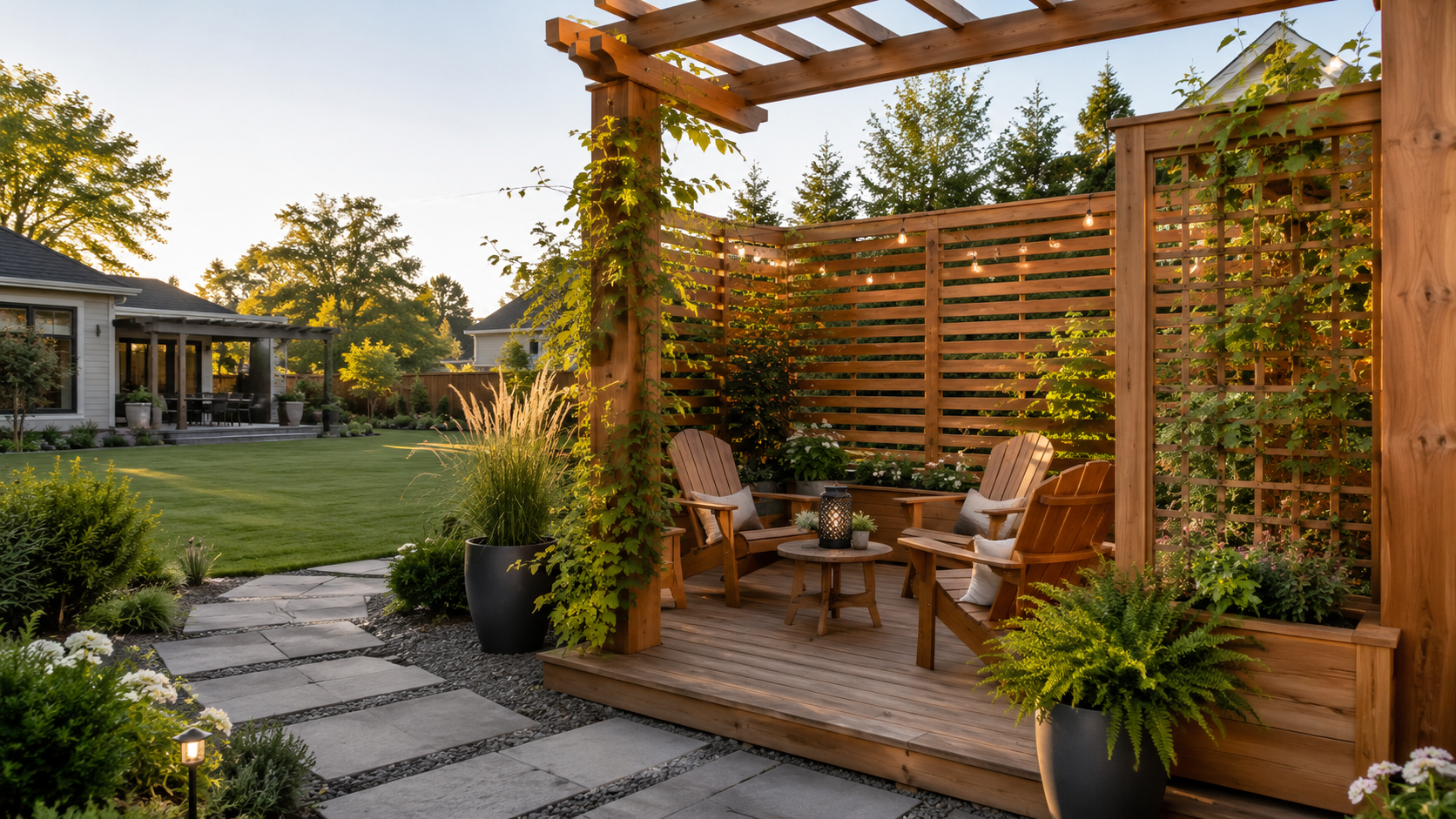
A pergola creates structure and defines an outdoor room.
While an open pergola does not provide complete privacy on its own, it gives you a framework for adding:
- Outdoor curtains
- Retractable shades
- Lattice panels
- Climbing vines
- Hanging planters
- Slatted side panels
- Decorative screens
Pergola-based backyard privacy ideas can address side views, overhead views, direct sunlight, and the need for a more defined outdoor room. A pergola can be especially helpful when the unwanted view comes from an upper-story window. Side screens address horizontal sightlines, while a canopy, shade panel, or vine-covered top can reduce views from above.
Summer Cedar’s cedar arbors and pergolas provide examples of structures that can help define an outdoor destination.
Among permanent backyard privacy ideas, a pergola can deliver privacy, shade, and architectural character in one project.
Avoid Making the Space Too Dark
Privacy does not require blocking every opening.
Consider the direction of the sun and prevailing breeze before enclosing the sides or roof.
You can preserve light by using:
- Spaced wood slats
- Open lattice
- Light-colored curtains
- Deciduous vines
- Retractable panels
- Screens placed only on exposed sides
The goal is to create comfort without turning an airy patio into a dark enclosure.
6. Hang Outdoor Curtains
Outdoor curtains offer immediate privacy and a softer appearance than a solid wall.
They can be attached to:
- Pergolas
- Covered patios
- Gazebos
- Deck structures
- Porch roofs
- Freestanding frames
Curtains allow you to adjust coverage based on the time of day and how you are using the space.
Open them when you want light and airflow. Close them when neighbors are outside, the sun is low, or you want more separation during dinner.
Outdoor curtains are among the easiest backyard privacy ideas for homeowners who already have an overhead structure.
Use Materials Designed for Outdoor Conditions
Choose fabric intended for exterior use.
Look for:
- UV resistance
- Mildew resistance
- Washable construction
- Reinforced hanging points
- Secure tiebacks
- Enough weight to reduce movement
- Hardware rated for outdoor use
Avoid leaving curtains closed and damp for long periods. Allow the fabric to dry and follow the manufacturer’s care instructions.
Secure curtains during storms and high winds.
7. Build a Slatted Privacy Wall
A slatted wall provides privacy while allowing some light and air to pass through. Horizontal slats create a contemporary look. Vertical boards can make the screen appear taller and may complement traditional garden structures.
Adjust the gap between boards based on the level of privacy you need. Narrow gaps provide more coverage. Wider spacing creates visual separation while maintaining an open feeling.
A slatted wall can also support:
- Hanging planters
- Exterior lighting
- Small shelves
- Decorative hooks
- Climbing plants
- Outdoor artwork
These backyard privacy ideas work especially well beside dining areas, benches, and compact patios.
Consider the Viewing Angle
Evenly spaced slats may appear open when viewed straight on but provide more coverage from an angle.
Before finalizing the spacing, test the screen from the neighbor’s likely viewing position.
You can also overlap boards or rotate slats slightly to block a specific direction while maintaining airflow.
8. Use Lattice for Partial Privacy
Lattice provides filtered screening without the visual weight of a solid fence.
It works well when you want to:
- Define a seating area
- Hide equipment
- Screen a side yard
- Support flowering vines
- Add height above a low wall
- Separate dining and lounging zones
Lattice may be made from wood, vinyl, composite materials, or metal. Select a material that complements your furniture and other backyard structures.
Diagonal lattice creates a traditional garden appearance. Square-grid panels often look more contemporary.
Lattice-based backyard privacy ideas can provide immediate partial coverage and greater screening as plants mature.
Frame the Lattice Properly
Unsupported lattice may warp, rattle, or become damaged in wind.
Install it within a stable frame and use outdoor-rated fasteners. Confirm that posts or supports can handle the expected wind load.
For a cohesive wood-focused yard, pair cedar lattice with cedar chairs, benches, or planters.
9. Create Privacy With Strategic Furniture Placement
Furniture does more than provide seating. It can define how people use and experience the yard.
Instead of placing furniture in the center of an open lawn, move the seating area closer to an existing privacy feature such as:
- A mature tree
- A garden wall
- A hedge
- The side of the house
- A shed
- A pergola
- A planted border
- A privacy screen
Furniture-focused backyard privacy ideas cost little to implement and can improve the space immediately. Turn chairs away from the exposed view and toward a focal point.
Possible focal points include:
- A fire pit
- A flower garden
- A water feature
- An outdoor fireplace
- A dining table
- A specimen tree
- A decorative screen
Furniture placement is one of the lowest-cost backyard privacy ideas because it uses elements you may already own.
Build a Smaller Outdoor Room
A large yard does not require a large seating arrangement.
Create an intimate zone using:
- Two Adirondack chairs
- A small side table
- A bench
- An outdoor rug
- A planter screen
- A trellis
- Focused lighting
A compact seating area is easier to screen than an entire lawn.
Summer Cedar’s Western Red Cedar chairs and ottomans can help create a defined conversation area within a larger open yard.
10. Add a Garden Arbor at an Entry Point
An arbor creates a visual transition between one part of the backyard and another.
Place an arbor:
- At the entrance to a patio
- Between the lawn and garden
- Along a walkway
- Before a secluded bench
- At the entrance to a pool area
- Between dining and relaxation zones
An arbor does not create a complete wall. Instead, it signals that you are entering a separate outdoor room.
Add side panels, lattice, vines, or shrubs to increase coverage.
These backyard privacy ideas work well when the goal is to create a sense of separation instead of completely blocking a neighboring property.
Use Repetition to Make the Arbor Feel Intentional
Connect the arbor to other landscape elements by repeating:
- Wood tone
- Plant varieties
- Path materials
- Lighting style
- Planter design
- Furniture shape
A cedar arbor feels more integrated when paired with cedar planters, seating, or trellis panels.
11. Use Shade Sails or Canopies for Overhead Privacy
Privacy problems do not always come from the side.
Neighboring decks, elevated properties, apartment windows, and second-story rooms may overlook your patio.
An overhead shade element can reduce that exposure.
Options include:
- Shade sails
- Retractable awnings
- Pergola canopies
- Market umbrellas
- Fabric panels
- Vine-covered structures
- Gazebos
An umbrella may be enough to shield a dining table or lounge chair from an elevated view.
Overhead backyard privacy ideas also provide shade, which can make the space more comfortable during hot weather.
Plan for Wind and Drainage
Shade sails and canopies create significant wind loads.
Install them according to manufacturer requirements and local building rules. Use secure attachment points and provide the recommended slope for water drainage.
Retract or remove fabric when severe weather is expected.
12. Combine a Fence With Landscaping
A fence provides immediate coverage. Plants soften its appearance and add height, texture, and seasonal color.
Instead of treating the fence as the finished landscape, plant in front of it.
Consider:
- Upright shrubs
- Flowering vines
- Ornamental grasses
- Small trees
- Raised beds
- Perennials
- Container plants
This combination can create greater depth than a fence alone.
A layered fence-and-planting approach is one of the most effective backyard privacy ideas for property lines that need consistent screening.
Avoid Planting Too Close to the Fence
Plants need enough room for their mature width and maintenance access.
Leave space to:
- Repair or stain the fence
- Prune plants
- Remove leaves and debris
- Check for drainage problems
- Maintain airflow
- Inspect posts and fasteners
Review the mature size of each plant before installation.
13. Create a Sunken or Lowered Seating Area
Changing elevation can reduce sightlines.
A patio or seating area positioned slightly below the surrounding landscape may feel more protected, especially when combined with:
- Retaining walls
- Raised planting beds
- Tall grasses
- Shrubs
- Built-in benches
- Planter walls
This is a more involved project and may require professional design, drainage planning, excavation, and permits.
However, lowered seating can create a strong sense of enclosure without relying on an unusually tall fence.
These backyard privacy ideas work best during a larger landscape renovation when grading changes are already being considered.
Prioritize Drainage
Any lowered outdoor space needs a reliable way to handle rainwater.
Consult a qualified landscape professional when excavation, retaining walls, or drainage systems are involved.
Water should move away from the house and should not collect around furniture or foundations.
14. Add Sound Privacy
Visual screening helps you feel less exposed, but noise can still travel between neighboring yards.
No backyard feature can eliminate all sound. You can make conversations feel less noticeable by introducing pleasant background sound and using layered landscaping.
Options include:
- A small fountain
- Moving water
- Rustling ornamental grasses
- Dense shrubs
- An outdoor-rated speaker used responsibly
- A tabletop water feature
- A properly designed landscape berm
Plants alone generally provide limited sound blocking unless the planting is deep, tall, and dense. Still, they can soften the environment and reduce the sense of direct exposure.
Combining visual and sound-focused backyard privacy ideas creates a more comfortable outdoor experience.
Be Considerate With Added Sound
A fountain can mask nearby conversation without creating a disturbance.
Keep speakers at a reasonable volume and direct them toward your home rather than neighboring properties.
The goal is to create a relaxing sound layer, not compete with surrounding noise.
15. Layer Several Backyard Privacy Ideas
The most successful privacy plans rarely depend on one feature.
A layered approach might include:
- A cedar screen beside the dining table
- Evergreen shrubs along the property line
- A trellis with vines near the patio
- An umbrella above the seating area
- Containers filling small gaps
- Furniture turned toward a garden focal point
Each element solves a different part of the problem. Combining several backyard privacy ideas lets each screen, plant, structure, and furniture piece solve a specific part of the overall problem.
The screen provides immediate coverage. Shrubs create long-term depth. The umbrella blocks an overhead view. Furniture orientation shifts attention inward.
Layered backyard privacy ideas also look more natural than one continuous wall.
Backyard Privacy Ideas for Small Yards
Small yards need carefully scaled solutions.
A tall, thick hedge may consume too much floor space. A full solid fence can make the yard feel confined.
Better options may include:
- Narrow trellis panels
- Wall-mounted planters
- Climbing vines
- Slim upright shrubs
- Outdoor curtains
- A compact pergola
- Corner screens
- Furniture placed close to the house
- One targeted overhead canopy
Use vertical space whenever possible.
A planter with a trellis can add greenery and privacy without requiring a wide planting bed.
In a small space, choose one attractive focal point and screen only the most exposed view. These focused backyard privacy ideas can make the yard feel protected without making it feel smaller.
Backyard Privacy Ideas Without a Fence
A fence may be restricted, expensive, or more permanent than you want.
You can create backyard privacy without a fence using:
- Freestanding screens
- Trellis planters
- Container trees
- Hedges
- Mixed shrub borders
- Pergolas
- Outdoor curtains
- Shade sails
- Arbors
- Strategic furniture placement
Freestanding features are especially useful for renters or homeowners who want to test a layout before making permanent changes.
The best backyard privacy ideas without a fence focus on the specific area where you spend time. Screening a 12-foot patio is more manageable than screening an entire property boundary.
Fast Backyard Privacy Ideas
Plants take time to grow. When you need immediate coverage, begin with a built feature.
Fast options include:
- Freestanding wood screens
- Outdoor curtains
- Large umbrellas
- Shade sails
- Lattice panels
- Reed or willow screening
- Tall container plants
- Trellis planter combinations
You can then add slower-growing plants behind or around the immediate screen.
This phased approach provides privacy now while improving the landscape over time.
Among fast backyard privacy ideas, screens and curtains usually provide the most immediate visual change.
Low-Maintenance Backyard Privacy Ideas
Every privacy solution requires some care.
Plants need watering and pruning. Wood may need cleaning or refinishing. Curtains require washing. Fences and screens need periodic inspection.
Lower-maintenance options may include:
- Composite privacy panels
- Properly selected evergreen shrubs
- Powder-coated metal screens
- Slow-growing native plants
- Simple wood screens without vines
- Large umbrellas with replaceable canopies
- Gravel beds around screen structures
Choose materials and plants suited to your climate.
A plant that thrives in your soil and rainfall pattern will usually require less intervention than one poorly matched to the site.
Ask your local Cooperative Extension office for plant recommendations before investing in a long hedge or living screen.
Avoid Invasive Privacy Plants
Fast growth can sound appealing when you want privacy quickly. It can also create years of maintenance problems.
Running bamboo is one example. NC State Extension distinguishes between clumping bamboo and running bamboo, noting that running types spread through underground rhizomes and can become difficult to manage.
Before planting bamboo or another fast-spreading plant:
- Confirm the exact species.
- Check state and local invasive-species lists.
- Understand its root or rhizome behavior.
- Learn the containment requirements.
- Consider the impact on neighboring properties.
- Review less aggressive alternatives.
Do not rely only on a general plant name at the garden center.
Responsible backyard privacy ideas should remain manageable within your property.
How Much Privacy Do You Really Need?
Complete visual isolation is not always necessary.
Partial screening may be enough to make your patio feel comfortable.
Ask yourself:
- Do I need year-round privacy?
- Is the problem limited to one season?
- Do I need coverage while seated or standing?
- Is the view coming from the side or above?
- Do I want to preserve a view beyond the neighboring property?
- How much sunlight am I willing to lose?
- How much maintenance will I accept?
- Does the space need airflow?
- Will the screen affect my neighbors?
A partially open screen can obscure direct views while keeping the backyard bright.
The most useful backyard privacy ideas create comfort without introducing a new problem.
Match Privacy Features to Your Furniture
Privacy structures and furniture should feel like parts of one outdoor plan.
Coordinate:
- Wood species
- Finish color
- Slat direction
- Hardware
- Scale
- Furniture placement
- Planter shape
- Lighting style
Western Red Cedar privacy panels pair naturally with cedar chairs, benches, tables, and garden structures.
Teak furniture can work well with neutral fabric curtains, mixed greenery, dark metal screens, and natural stone.
Summer Cedar’s collection of outdoor patio furniture includes Western Red Cedar and Java teak options for creating dining, lounging, and conversation areas.
Once you establish the private zone, furnish it around the way you plan to use it.
Create a Private Dining Area
For outdoor dining, place the table near an existing wall, hedge, or screen.
Add privacy through:
- A trellis along the exposed side
- Tall planters at the corners
- A market umbrella overhead
- A pergola with curtains
- Layered shrubs behind the seating
- Warm lighting directed toward the table
Keep enough clearance for guests to pull out chairs and walk around the table.
A privacy screen should support the dining experience without blocking access or trapping grill smoke.
These backyard privacy ideas can turn an open dining table into a defined outdoor room.
Create a Private Conversation Area
A conversation area can be smaller and easier to screen than a dining zone.
Start with:
- Two to four chairs
- A small table
- An outdoor rug
- A planter screen
- A trellis or lattice panel
- One shade umbrella
- Soft lighting
Angle the chairs toward each other and away from the exposed view.
Place the screen behind the seating instead of directly in front of it. This creates a protected feeling without closing the view from the chairs.
Summer Cedar’s article on designing a Zen backyard offers additional ideas for creating a quieter outdoor retreat.
Common Backyard Privacy Mistakes
Privacy improvements should make the yard more usable. Avoid choices that create maintenance, safety, or design problems. The best backyard privacy ideas improve comfort while preserving access, airflow, sunlight, and room for routine maintenance.
Screening the Entire Yard Without a Plan
Start with the area you use most.
Targeted backyard privacy ideas cost less and may produce a better result.
Ignoring Mature Plant Size
A small nursery plant may become wider than the space available.
Review mature height and width before planting.
Choosing Growth Speed Over Suitability
A fast-growing plant may require frequent pruning, heavy watering, or containment.
Choose the right plant for the site.
Blocking Sunlight and Airflow
A solid wall may cast shade over gardens, windows, and neighboring property.
Test the height and location first.
Installing Screens Without Wind Planning
Freestanding panels, curtains, and canopies must withstand local weather.
Use proper anchors and installation methods.
Forgetting the View From Inside
Your privacy structure becomes part of the view from your windows.
Choose a screen or planting you will enjoy seeing throughout the year.
Creating a Maintenance Trap
Leave access behind fences, screens, and plantings for cleaning, pruning, and repairs.
A Simple Backyard Privacy Planning Checklist
Use this checklist before selecting a solution:
- Identify the unwanted view.
- Measure the required width.
- Estimate the necessary height.
- Check the view while seated.
- Check elevated sightlines.
- Note sun and wind exposure.
- Confirm property lines.
- Review local rules.
- Locate utilities.
- Decide how quickly you need coverage.
- Set a maintenance budget.
- Choose permanent or movable features.
- Test the location.
- Coordinate materials with your furniture.
- Plan for mature plant size.
This process will help you compare backyard privacy ideas based on function instead of appearance alone.
Frequently Asked Questions About Backyard Privacy Ideas
What is the fastest way to create privacy in an open backyard?
A freestanding privacy screen, outdoor curtain, lattice panel, large umbrella, or shade sail can provide immediate coverage. Place the feature close to the seating area to block the relevant sightline efficiently.
How can I create backyard privacy without building a fence?
Use freestanding screens, trellis planters, container plants, pergolas, curtains, mixed shrubs, arbors, or strategic furniture placement. Target the patio or seating area instead of trying to screen the entire property.
What plants are best for backyard privacy?
The best plants depend on your climate, soil, sunlight, available width, and desired height. Consult your local Cooperative Extension office for region-specific recommendations. Mixed plantings often provide more resilience and visual interest than a single-species hedge.
How can I block a neighbor’s second-story view?
Use an overhead element such as a pergola canopy, shade sail, market umbrella, or small tree canopy. Combine it with a side screen to address the view from multiple angles.
Can I use bamboo for backyard privacy?
Some clumping bamboo varieties can be manageable in appropriate climates. Running bamboo can spread aggressively through underground rhizomes. Confirm the species and review local invasive-plant guidance before planting.
How tall should a backyard privacy screen be?
The correct height depends on the viewing angle, distance, seating elevation, and local regulations. Test the sightline with a temporary panel and check municipal or homeowners association height restrictions before installation.
How do I make a privacy screen look attractive?
Coordinate the screen with your furniture and landscape. Add climbing plants, planters, lighting, or repeated wood tones. Leave enough open space to preserve airflow and natural light.
Turn Your Open Backyard Into a Private Retreat
Backyard privacy ideas work best when they address the way you use your outdoor space. Start with one or two backyard privacy ideas around your most-used seating area, then add more coverage as your needs and landscape develop.
Begin with the sightline that makes you feel exposed. Decide whether you need immediate screening, long-term landscaping, overhead coverage, or a combination of several features.
A cedar screen can provide privacy today. Trellis plants can add coverage over time. A pergola or umbrella can address views from above. Strategic furniture placement can make a large open yard feel like a series of comfortable outdoor rooms.
You do not need to hide the entire property. Create privacy around the spaces that matter most, then preserve the light, airflow, and openness you enjoy.
When you are ready to furnish your private backyard retreat, shop Summer Cedar’s collection of Western Red Cedar and Java teak patio furniture. Explore chairs, benches, swings, tables, planters, trellises, and garden structures designed to help you create a comfortable outdoor space.